What the musicians play
Uzbek instruments: doira and karnay
A listener's guide to the traditional instruments of Uzbekistan, from lutes such as the dutor to the doira frame drum and the karnay long trumpet.
Reserve a seat in Samarkand ↗Quick answer
Wikipedia groups the traditional instruments of Uzbekistan into strings, winds and percussion. The strings include the long-necked fretted lutes dutor, rubob and tanbur and the gʻijjak spike fiddle. The winds include the karnay long trumpet and the surnay oboe. The percussion includes the doira frame drum. UNESCO's description of Shashmaqom names lutes, fiddles, frame drums and flutes.
Three families
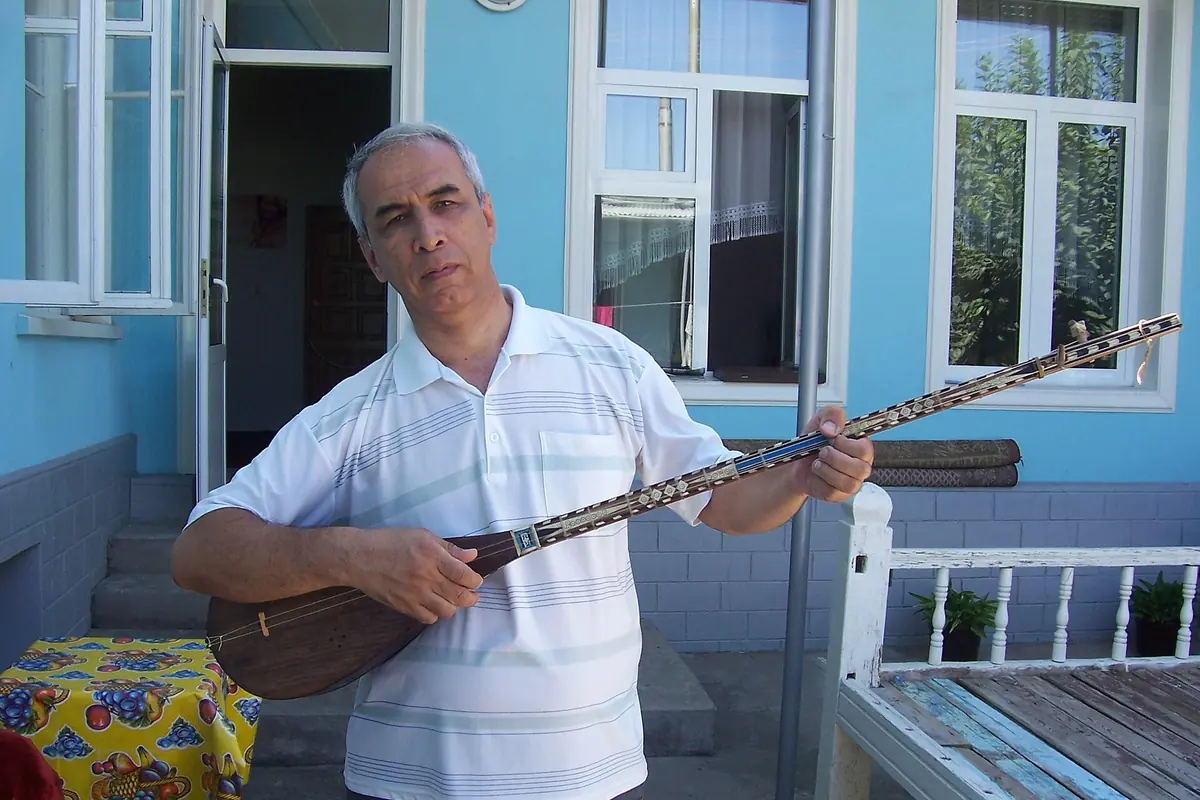
Wikipedia's article on the music of Uzbekistan lists the traditional instruments in three groups: string, wind and percussion. Together they run from plucked lutes to long trumpets. The ticket for the Marokand Concert Hall says only that live musicians fill the hall with Uzbek melodies, so this guide describes the instruments in general. It cannot say which of them play on a given night.
Strings: the lutes
Wikipedia lists the dutor, the rubob, the tanbur, the tor and the ud as long-necked fretted lutes, alongside the gʻijjak, a spike fiddle, and the chang, a struck zither. UNESCO describes the Shashmaqom orchestra as lutes, fiddles, frame drums and flutes, which shows how central the strings are to the classical tradition.
Winds: flutes, oboe and long trumpet
The wind instruments on Wikipedia's list are the dili tuiduk, the karnay, described as a long trumpet, the nay, a side-blown flute, the qoʻshnay, a clarinet-like instrument made from reed, and the surnay, a loud oboe. Wikipedia's Registan article records that royal proclamations on the square were heralded by blasts on enormous copper pipes called dzharchis, a reminder that loud wind instruments once carried public announcements.
Percussion: the doira
Wikipedia names the doira as a frame drum, and the nogʻora as a pot-shaped drum covered with leather on top, with the dovul, the qoshiq, which are spoons, and the zang, which are bracelets. UNESCO's Shashmaqom file lists frame drums in the ensemble, so rhythm is part of the classical tradition as well as the folk. Wikipedia describes Uzbek music as characterised by complicated rhythms and meters, which is a good reason to listen to the drum.
Names and spellings
Instrument names appear in several spellings. Wikipedia's list for Uzbekistan writes dutor and rubob, and it marks some names with a raised sign, as in gʻijjak, nogʻora and qoʻshnay, which belongs to the Uzbek Latin alphabet. If you search for recordings, teachers or museum pieces, try both the Uzbek spelling and the older English one, since a search engine treats them as different words. Where the same instrument has two names, the one on a programme or a label is a good guide to which tradition is being described.
Instruments in Shashmaqom
UNESCO says Shashmaqom is performed solo or by a group of singers and an orchestra of lutes, fiddles, frame-drums and flutes. It says performances generally open with an instrumental introduction followed by the nasr, the main vocal section, and Wikipedia adds that interludes of spoken Sufi poetry interrupt the music. Shashmaqom is a formal classical tradition, so a theatrical concert show is a different format. It is still a helpful model for how voices and instruments are combined.
Listening in the hall
A few habits make a live show more rewarding. Listen first for the drum, then for the melody on top of it, and then for the singer if there is one. Watch the players' hands on a drum or lute, and notice when a wind instrument enters. A theatre with professional sound, as the ticket describes the hall, should give the instruments room to be heard.
Who this isn't for
This guide is a vocabulary, and not a technical study. It does not describe how the instruments are tuned or built, and it cannot promise that a given instrument will appear on your night. If you want to learn an instrument, look for a teacher; if you want a recital of a particular repertoire, look for a dedicated concert. For a listener who wants to put names to sounds, the Wikipedia list is a fair start.
Frequently asked questions
What is a doira?
A frame drum. Wikipedia lists it among the traditional percussion instruments of Uzbekistan.
What is a karnay?
A long trumpet. Wikipedia lists it among the traditional wind instruments of Uzbekistan.
What is a dutor?
A long-necked fretted lute. Wikipedia lists it among the traditional string instruments of Uzbekistan.
Will these instruments be in the show?
The ticket promises live musicians but does not itemise instruments, so none is promised.
Sources